What this guide decides.
This page decidesWhether a 358 mesh system belongs on the shortlist and which system decisions must follow.
This page does not decideA security rating, attack delay, structural design or project approval from the mesh name alone.
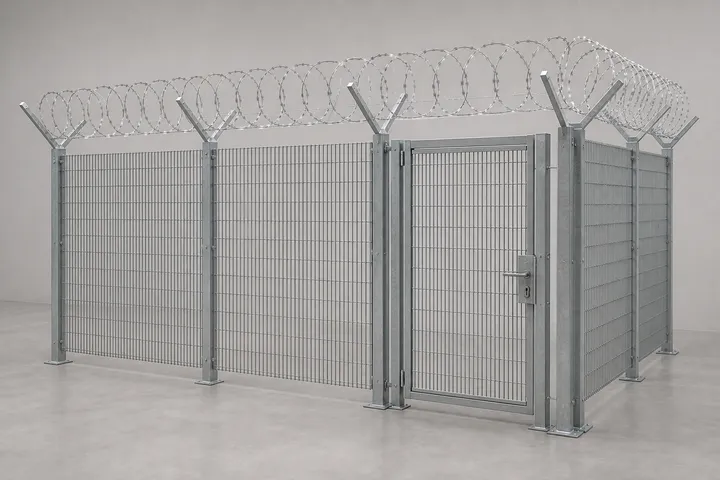
Start with the threat, not the aperture.
A 358 designation commonly describes a tight welded-wire mesh geometry. It does not identify the post, fixing, gate, topping, foundation or tested configuration. Record the protected asset, likely adversary actions, required delay or deterrence, observation needs and response concept before selecting components.
Choose the perimeter role.
Common routes include visible demarcation around sensitive assets, restricted compounds, utility and substation boundaries, transport or logistics perimeters, detention-related boundaries and internal high-security zones. Each route changes access, inspection, privacy, detection and local approval requirements.
Define the complete system.
Compare the panel, post centres, connection method, fastener access, gate leaves, hinges and locks, bottom interface, corners, level changes, topping, finish, spare parts and installation boundary. A stronger-looking panel cannot compensate for an unresolved gate or ground gap.
Separate product supply from project design.
The supplier can respond to a controlled schedule and drawings. The responsible project team must confirm the threat assessment, security category, structural actions, foundations, electrical clearances, emergency access and jurisdiction-specific requirements.
Compare commercial completeness, not a panel rate.
Ask each bidder to identify included fence length, height profile, openings, corner and transition pieces, posts, connections, toppings, finish, spares, packing, delivery assumptions, documents and excluded civil or installation work. Record options separately from the compliant base offer. This exposes where a lower apparent price depends on missing gates, lighter interfaces, unpriced transitions or unresolved project responsibilities.
Turn the site brief into a shortlist.
Use the operating situation to decide what must be compared. Do not use this table as a performance rating or final design.
Make the selection in four controlled passes.
Each pass should leave a written output that can be reviewed by the next responsible party.
- 01
Define the perimeter job
Record the asset, boundary role, operating environment, access pattern, observation concept and response assumptions. If these are unknown, hold the product decision open.
- 02
Map every interface
Mark gates, corners, slopes, walls, drains, service crossings, vehicle routes, electrical zones and adjoining barriers on the same fence-line drawing.
- 03
Normalize candidate systems
Compare the offered panel, post, connection, gate, topping, finish, civil boundary, spares, documents and packing on one schedule.
- 04
Release with open items visible
Identify confirmed choices, responsible approvals, deviations and unresolved design inputs. Do not let a quotation silently close an engineering or security decision.
Project-input schedule.
Carry these fields into the enquiry, drawing review and approval record. Mark unknowns as open items instead of guessing.
Questions that should be answered before quotation.
- What asset and operating area does each fence run protect?
- Which openings must remain available during normal, emergency and maintenance conditions?
- Is a named tested or certified configuration required, and who accepts deviations?
- Which gates, toppings, detection devices, civil works and services sit inside the supply boundary?
- Which dimensions come from a current survey rather than a typical drawing?
- What information must be approved before fabrication, packing or shipment release?
When this specialist guide is not the right page.
Use the general welded-mesh guide when the project only needs an ordinary commercial, garden or light-duty welded-mesh form and has no defined security threat, delay or evidence objective.
Open the general welded-mesh selection guide →